

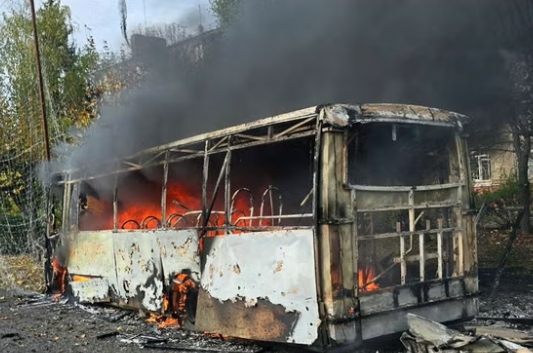
Ukraine’s counter-offensive on the Lyman axis collapsed the northern arm of a Russian pincer movement aimed at surrounding Ukrainian-held Donetsk, liberating up to 176 square kilometres and forcing Russian units onto the defensive, the Washington-based think tank said.
Ukrainian forces have derailed Russia’s plan to encircle and occupy the remaining Ukrainian-controlled territory of the Donetsk region this year, the Washington-based think tank Institute for the Study of War (ISW) concluded in an assessment based primarily on open-source intelligence.
The Russian campaign centred on a deep pincer movement targeting what the report calls the “fortress belt” — a defensive and logistical network protecting the Ukrainian-held portion of the Donbas — advancing from Lyman in the north and Dobropillia in the south-west, with both arms intended to link up near Barvinkove in the Kharkiv region.
Completing such an encirclement would have gone a long way towards Moscow’s longstanding objective of occupying all of Donetsk region and would have given the Kremlin something to show Russian society for the costs of the war.
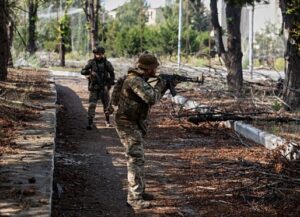
Ukrainian forces advanced along the Ridkodub–Nove–Novomykhailivka line in the north and the Yarova–Drobysheve–Stavky line in the south, collapsing the salient Russia had built to threaten Sloviansk from the north-east and forcing Russian units onto the defensive.
Commander of Ukraine’s 3rd Army Corps Andrii Biletskyi said the first three phases of the operation in mid- to late September liberated 176 square kilometres of territory.
Ukraine’s President Volodymyr Zelenskyy put the figure at between 125 and 140 square kilometres as of 3 October, adding that Russian losses had risen sharply over the preceding two to three months.
The defeat of the northern pincer forced Russia to abandon its plans to advance on Sloviansk from the north-east and deprived it of positions intended to threaten northern approaches to the fortress belt.
Based on geolocated photo and video footage, satellite imagery and visually confirmed data, the institute calculated that Russian assault units had in reality been pushed out of at least 80 square kilometres in September.
Russia’s net retreat in September rose to 175.18 square kilometres, including areas it temporarily penetrated but did not hold.
The Kremlin-aligned channel Rybar, on Telegram, said on October 7 that Moscow’s forces were losing villages south of Lyman, a town they have tried to capture as a springboard to mount a full-scale offensive on the “fortress belt” cities of Sloviansk and Kramatorsk.
“The enemy is using successes in the Lyman direction to develop attacks [east of Sloviansk], where Russian troops are forced to defend previously occupied positions and expend resources on restoring control, instead of launching their own offensive,” wrote Rybar.
“It is becoming increasingly clear that the possibility of storming the urban area [of Sloviansk] is receding into the more distant future.”