

5.10.2026
Germany and Russia are drawing close to starting another war, the country’s foreign intelligence chief warned on Monday.
According to Martin Jaeger Moscow was waging an increasingly aggressive “shadow war” against European democracies and that attacks targeting Germany remained “real and imminent”.
“The confrontation we are facing with Russia has taken on a new, more dangerous dimension,” Martin Jaeger, head of the Bundesnachrichtendienst (BND), told the annual public hearing of intelligence chiefs in Parliament.
“Germany is in danger of becoming embroiled in a violent conflict with Russia,” he said, citing an attempted drone attack at Leipzig airport in August as one example.
German authorities have repeatedly accused Moscow of conducting a hybrid campaign against European countries involving drones, cyberattacks, sabotage and other forms of intimidation.
Jaeger’s warning comes against the backdrop of a relationship between Berlin and Moscow that has undergone a dramatic transformation since the end of the Cold War.
Germany is not at war with Russia, but drones, cyberattacks, sabotage and nuclear threats are increasingly testing the line between confrontation and direct conflict.
The warning also carries historical resonance for Germany. In 1914, under Kaiser Wilhelm II, strategic rivalry and a complex system of alliances tipped Europe into the First World War, with Germany declaring war on Tsarist Russia and German and Russian forces clashing on the Eastern Front.
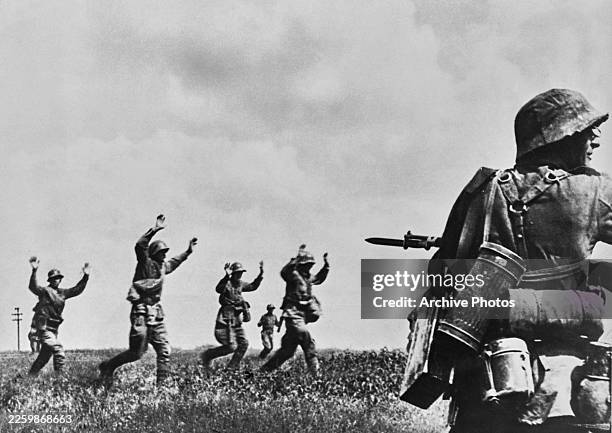
In 1939, shortly before the outbreak of the Second World War, Nazi Germany and the Soviet Union signed a non-aggression pact. Two years later, Hitler invaded the Soviet Union, a decision that became one of his most consequential strategic failures.
After 1945, West Germany became a central part of a European security architecture designed to prevent another continental catastrophe.
Its integration into Nato was built around the principle that economic and political interdependence could help prevent a return to the conflicts that had devastated the continent.
Today Germany is once again confronting the prospect of a prolonged strategic rivalry with Moscow. As Russia tests that post-war security order, Berlin is weighing how far it can confront the Kremlin without becoming directly involved in a wider conflict.
Jaeger’s warning also marks a reversal in Germany’s relationship with Russia.
For years, Berlin and Moscow maintained close economic ties, with Russian energy helping power Germany’s export-driven industrial economy. Under Chancellor Gerhard Schröder and later Angela Merkel, Germany pursued engagement with Vladimir Putin even after Russia’s annexation of Crimea in 2014. Reuters