

5.7.2026
More than 17 million people across nine conflict-hit states in northern Nigeria face severe hunger, the UN’s food agency (WFP) has said.
The WFP warned that violence and funding cuts are driving food insecurity to its worst level in nearly a decade. Stripped of their livelihoods, some people are fleeing across the border into neighbouring Benin.
The latest food security analysis showed the number of people facing crisis, emergency or catastrophic hunger had risen by almost two million from previous projections, the World Food Programme (WFP) said in a statement published Thursday.
The findings underline the deepening humanitarian cost of insecurity in Africa’s most populous country, where Islamist insurgents in the northeast and armed gangs in parts of the north have displaced communities, kept farmers from their fields and restricted aid access.
The crisis is worsening during the lean season, when households typically exhaust food stocks before the next harvest.
In Borno state, the epicentre of a long-running Islamist insurgency, more than 3 million people are acutely short of food. More than 750,000 of them are facing severe hunger conditions, WFP said.
“When people lose access to food, the risks of displacement, exploitation and instability increase,” said WFP regional director for West and Central Africa Kinday Samba, adding that violence was spreading across a wider area and forcing people from farmland.
WFP said it can support fewer than half of the 1.3 million people it was able to assist last year in three northeast states, where 6.2 million are suffering from acute hunger – nearly 13 percent more than a year ago.
In some areas, the WFP has already recorded phase 5, the most critical level in the hunger classification system.
The agency said it needs $89 million over the next six months to maintain food, nutrition and logistics support across northern Nigeria.
The WFP describes a “double trap” as conflict cuts people off from essential services, while funding cuts cuts reduce humanitarian aid. RFI
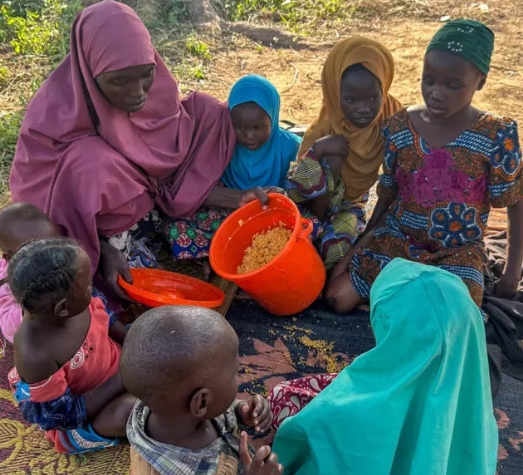 A displaced woman and children surviving.